











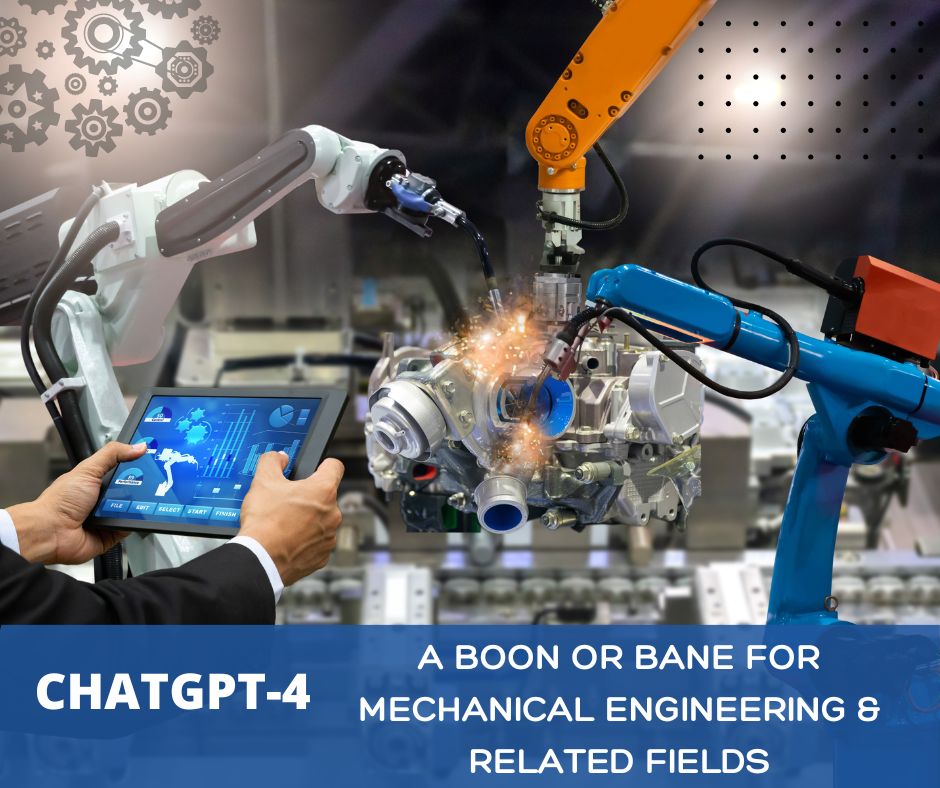
Artificial intelligence is changing the way students learn, solve problems, and prepare for their careers. In mechanical engineering, AI tools such as ChatGPT can make it easier to understand complex concepts, explore design ideas, and work through technical challenges. From explaining difficult formulas to helping with project documentation, these tools can be useful throughout the learning process.
However, AI is not a replacement for engineering knowledge or practical experience. Students need to understand how to use it effectively, verify the information it provides, and apply their own judgement. Let's explore how ChatGPT can support mechanical engineering students, where its limitations lie, and how it can complement their academic and professional development.
Understanding ChatGPT and Its Role in Engineering
ChatGPT is an AI-powered conversational tool developed by OpenAI. It can explain concepts, summarise information, generate code, and help users approach problems from different perspectives. Its usefulness depends on the quality of the prompt and the accuracy of the information it produces.
For students pursuing B.Tech Mechanical Engineering, it can serve as an additional learning resource for subjects such as thermodynamics, fluid mechanics, material science, and machine design. For example, a student struggling to understand heat transfer can ask for a simpler explanation, a practical example, or a step-by-step breakdown of the concept.
The key is to use AI to improve understanding rather than simply copy its answers. Textbooks, classroom discussions, laboratory work, and reliable technical references remain essential parts of engineering education.
How ChatGPT Can Help Mechanical Engineering Students
1. Making Complex Concepts Easier to Understand
Engineering subjects often involve mathematical equations, scientific principles, and technical terminology that take time to master. ChatGPT can explain these concepts in simpler language and provide examples that connect theory with everyday applications.
A student learning about fluid mechanics, for instance, could ask how pressure changes with depth or how fluid flow behaves inside a pipe. Such explanations can provide a useful starting point before moving on to numerical problems and practical experiments.
Students should still check important formulas, calculations, and technical explanations against trusted academic resources.
2. Supporting Design Ideas and Innovation
Designing a mechanical component requires more than coming up with an idea. Engineers must think about materials, manufacturing methods, durability, operating conditions, cost, and safety.
ChatGPT can help students organise these requirements and explore possible approaches during the initial design stage. For example, when developing a small mechanical device for a college project, students can use it to brainstorm design alternatives or create a preliminary checklist of factors to investigate.
These suggestions can help structure the design process, but they do not establish whether a design is safe or suitable. CAD modelling, engineering calculations, testing, and validation are still necessary before a design can be implemented.
3. Helping with Troubleshooting and Problem-Solving
Identifying the cause of a mechanical fault can be challenging, particularly when several factors may be responsible. AI tools can help students understand possible causes and plan a logical troubleshooting process.
Suppose a motor is producing unusual vibrations. ChatGPT might suggest checking alignment, mounting, bearing condition, or imbalance. This gives the student a starting point for investigating the issue rather than guessing at a solution.
In real working environments, these possibilities must be confirmed through inspection, measurements, equipment manuals, and established safety procedures. AI-generated suggestions should never be treated as a confirmed diagnosis.
4. Assisting with Coding and Engineering Projects
Modern engineering projects sometimes involve programming, numerical calculations, and computer-based analysis. ChatGPT can explain programming concepts, suggest ways to organise code, help identify errors, and clarify the logic behind a calculation.
Students working with Python or MATLAB, for example, can ask for explanations of a mathematical function or guidance on structuring a simple calculation program. This can make unfamiliar technical tasks easier to approach.
Generated code must always be tested, and calculations should be checked independently. Similarly, actual engineering simulations require appropriate software, suitable input data, correct boundary conditions, and validation of the results.
5. Improving Technical Writing and Documentation
Preparing project reports, laboratory records, and technical presentations is another important part of engineering education. ChatGPT can help students organise their ideas, improve sentence clarity, and structure a report into logical sections.
It can also help explain how to present a methodology, describe experimental observations, or summarise project findings. However, students should ensure that their reports accurately reflect the work they performed and the results they obtained.
Following university guidelines on academic integrity and AI use is essential. The purpose should be to communicate technical work more clearly, not to misrepresent someone else's work as one's own.
What Are the Limitations of ChatGPT in Mechanical Engineering?
Although AI can be helpful, it does not always provide accurate or complete answers. It may produce incorrect calculations, overlook important operating conditions, or present an explanation that sounds convincing but is technically wrong.
Mechanical engineering decisions often depend on precise measurements, material properties, manufacturing tolerances, and safety requirements. An answer that works as a general explanation may not be appropriate for an actual industrial application.
Students and professionals should verify important information using engineering textbooks, manufacturer specifications, relevant standards, and qualified experts. Confidential project information should also be handled according to applicable data protection policies.
The most effective approach is to treat ChatGPT as a supporting tool while keeping technical judgement, practical testing, and professional responsibility at the centre of every engineering decision.
Career Opportunities in AI-Assisted Engineering
AI is becoming increasingly relevant to product development, manufacturing, robotics, predictive maintenance, and computational design. For mechanical engineering graduates, understanding these technologies can complement their existing technical knowledge and help them explore different career paths.
Depending on their interests and additional skills, graduates may work in areas such as product design, manufacturing automation, simulation and analysis, robotics, or research and development. These roles can require knowledge of CAD software, programming, mathematics, data analysis, and industry-specific tools.
Students interested in advanced studies can also explore the M.Tech Mechanical Engineering programme. Postgraduate education can provide opportunities to deepen technical understanding and pursue specialised academic or research interests.
AI skills alone do not guarantee a particular job or career outcome. Building a strong engineering foundation, completing practical projects, and gaining relevant experience remain important steps towards professional growth.
Studying Mechanical Engineering at CGC University, Mohali
Choosing an engineering programme is an important decision, and students should look beyond the course title when comparing their options. The curriculum, laboratory facilities, practical projects, internship opportunities, faculty support, and eligibility requirements can all influence the learning experience.
At CGC University, Mohali, students can explore the available engineering programmes and review the course details that align with their interests. Those considering a career in mechanical engineering should examine the subjects covered, practical learning opportunities, and skills they can develop throughout the programme.
Building a career in engineering takes consistent effort. Developing problem-solving abilities, learning relevant software, participating in projects, and staying curious about new technologies can help students make the most of their academic journey.
Conclusion
ChatGPT can be a useful companion for mechanical engineering students when it is used thoughtfully. It can help explain difficult concepts, generate initial design ideas, support coding tasks, and improve technical documentation. At the same time, its responses need to be checked before being used for calculations, designs, or practical engineering decisions.
The real advantage comes from combining AI tools with strong subject knowledge, hands-on experience, and independent thinking. By developing these abilities together, students can strengthen their technical skills and prepare for the changing demands of the engineering profession.