









Choosing the right engineering degree after Class 12 is an important decision for students interested in technology, innovation and engineering careers. Two of the most popular undergraduate engineering qualifications in India are Bachelor of Engineering (B.E.) and Bachelor of Technology (B.Tech).
Students often search for the difference between B.E. and B.Tech, the B Tech full form, eligibility criteria, course duration, admission requirements, fees and career opportunities. Although both degrees prepare students for engineering careers, understanding their similarities and differences can help students make an informed decision.
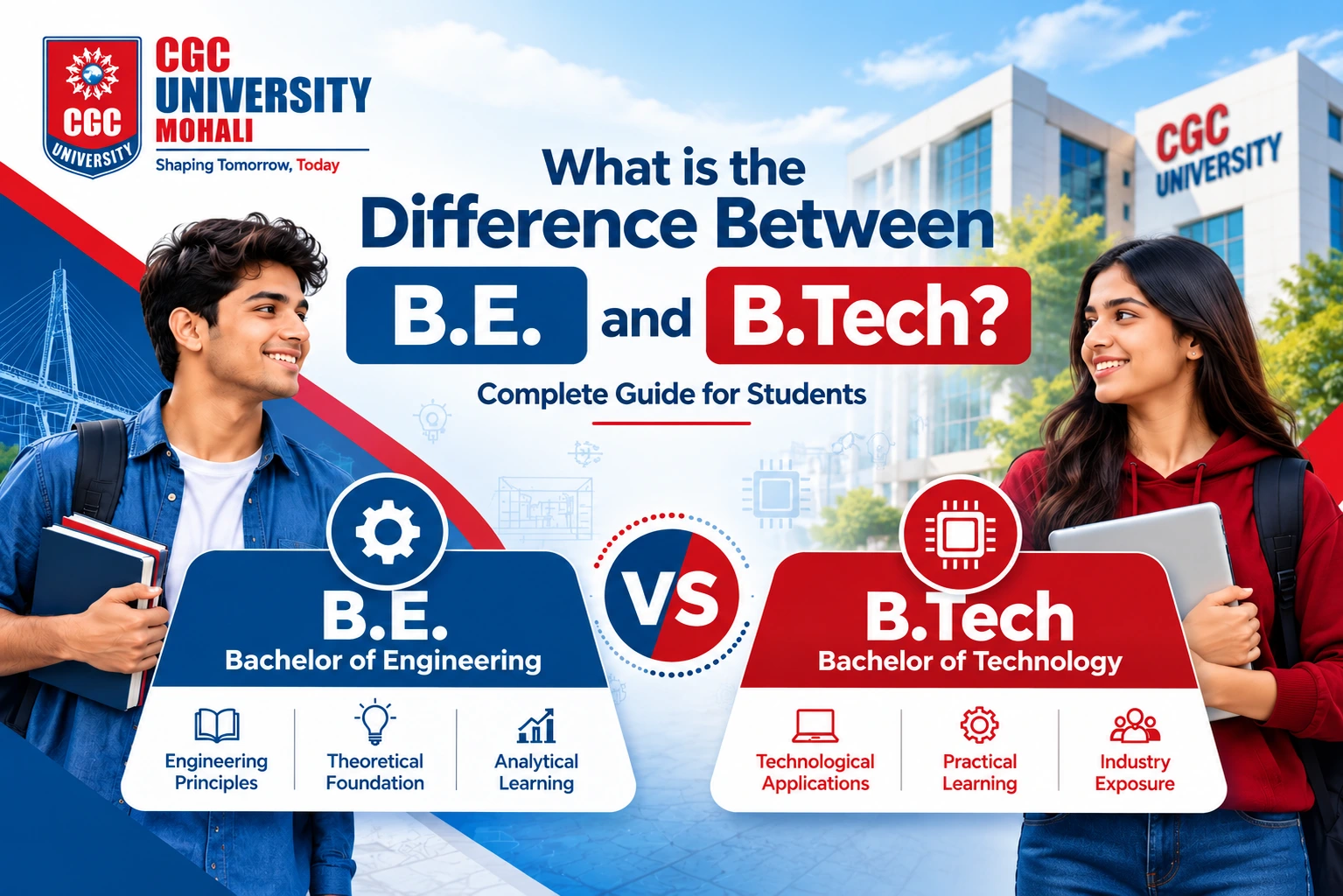
B.E. is traditionally associated with engineering principles and theoretical foundations, while B.Tech is commonly associated with technological applications. However, modern engineering programmes often combine theoretical knowledge, laboratory training, industry projects and practical learning, regardless of the degree title.
This guide explains B.E. vs B.Tech, the B Tech full form, popular engineering courses, admission requirements and career opportunities. Students interested in engineering education in Punjab can also consider B.Tech courses at CGC University, Mohali.
B.E. vs B.Tech: What is the Main Difference?
The main difference between B.E. and B.Tech is their traditional academic emphasis. B.E. stands for Bachelor of Engineering, while B.Tech stands for Bachelor of Technology. Both are undergraduate engineering qualifications that generally take four years to complete in India.
B.E. is often described as focusing on engineering theory, while B.Tech is associated with applied technology. In practice, both qualifications can include engineering mathematics, scientific principles, laboratories, internships, design assignments and technical projects.
Neither degree is automatically better. The most important factors are the engineering specialisation, university recognition, curriculum, practical learning opportunities and career goals.
What is the Full Form of B.Tech?
The B Tech full form is Bachelor of Technology. B.Tech is an undergraduate engineering degree that generally takes four years to complete in India. The programme combines engineering fundamentals, technical knowledge, laboratory work and practical applications.
Students searching for the B Tech full form in engineering should understand that Bachelor of Technology is a qualification offered across multiple engineering disciplines, including Computer Science, Mechanical Engineering, Civil Engineering and Electronics and Communication Engineering.
B.Tech Full Form and Course Overview
- Full Form: Bachelor of Technology
- Abbreviation: B.Tech or BTech
- Degree Level: Undergraduate
- Course Duration: Usually four years
- Semesters: Usually eight
- Eligibility: Class 12 with prescribed subjects and qualifying marks
- Admission: Entrance examination, counselling or institution-specific selection, as applicable
- Popular Branches: Computer Science, Artificial Intelligence, Electronics, Mechanical Engineering and Civil Engineering
Why Do Students Choose B.Tech After 12th?
B.Tech is a popular academic option for students interested in programming, software development, artificial intelligence, robotics, electronics, manufacturing and infrastructure development.
Engineering education helps students develop technical knowledge, analytical thinking, practical problem-solving abilities and skills relevant to different industries.
Students planning to pursue B.Tech after 12th at CGC University can compare available engineering specialisations according to their interests and career goals.
What is B.E. (Bachelor of Engineering)?
The full form of B.E. is Bachelor of Engineering. It is an undergraduate engineering degree that develops students' understanding of mathematics, scientific principles, engineering design and technical problem-solving.
The B.E. programme generally takes four years to complete and is divided into eight semesters. Students study foundational engineering subjects before progressing to specialised topics in their chosen branch.
Although B.E. is sometimes described as more theory-oriented, many programmes also include laboratories, workshops, practical assignments, industrial training and final-year engineering projects.
Key Features of a B.E. Degree
- Usually a four-year undergraduate engineering programme.
- Provides knowledge of engineering fundamentals and scientific principles.
- Includes mathematics, engineering design and technical subjects.
- Develops analytical and problem-solving skills.
- Includes laboratory sessions, practical assignments and projects.
- Offers opportunities for technical employment and postgraduate education.
What is B.Tech (Bachelor of Technology)?
B.Tech, or Bachelor of Technology, is an undergraduate engineering programme that combines scientific knowledge, engineering concepts and technological applications.
The curriculum commonly includes classroom instruction, laboratory experiments, technical assignments, workshops, engineering projects and opportunities for internships.
B.Tech programmes are available in traditional engineering disciplines as well as emerging areas such as Artificial Intelligence and Machine Learning, Data Science, Cyber Security, Cloud Computing and Robotics.
Key Features of a B.Tech Degree
- Usually four years divided into eight semesters.
- Combines engineering fundamentals with technological applications.
- Includes laboratories, workshops and technical projects.
- Offers specialisations in traditional and emerging engineering fields.
- Develops technical, analytical and problem-solving skills.
- Provides pathways to employment, entrepreneurship and higher education.
Difference Between B.E. and B.Tech:
The following comparison highlights the major similarities and traditional differences between Bachelor of Engineering and Bachelor of Technology.
| Comparison Factor | B.E. (Bachelor of Engineering) | B.Tech (Bachelor of Technology) |
|---|---|---|
| Full Form | Bachelor of Engineering | Bachelor of Technology |
| Degree Level | Undergraduate | Undergraduate |
| Course Duration | Usually 4 years | Usually 4 years |
| Semesters | Usually 8 | Usually 8 |
| Traditional Academic Emphasis | Engineering principles and theory | Technological applications |
| Practical Training | Laboratories, workshops and projects | Laboratories, workshops and projects |
| Eligibility | Prescribed Class 12 qualifications | Prescribed Class 12 qualifications |
| Admission Process | Entrance examinations, counselling or institutional selection | Entrance examinations, counselling or institutional selection |
| Career Opportunities | Engineering, technology, research and management | Engineering, technology, research and management |
| Higher Education | M.E., M.Tech, MBA and other eligible postgraduate programmes | M.E., M.Tech, MBA and other eligible postgraduate programmes |
Important: These differences describe traditional academic perceptions rather than fixed rules. Modern B.E. and B.Tech programmes may have very similar curricula, learning methods and career opportunities.
B.E. vs B.Tech: Which is Better?
One of the most frequently asked questions among engineering aspirants is "B.E. vs B.Tech: Which is better?" Both qualifications can provide a strong foundation for engineering careers.
A B.E. programme may appeal to students interested in engineering fundamentals, mathematical concepts and technical design. A B.Tech programme may appeal to students interested in technology-focused specialisations and applied engineering projects.
However, the degree title alone should not determine the choice. Students should compare the actual curriculum, academic facilities, practical training opportunities and career pathways.
Factors to Consider Before Choosing B.E. or B.Tech
- Engineering Specialisation: Choose a branch aligned with your interests and career goals.
- Course Curriculum: Review subjects, electives, laboratory training and technical projects.
- University Recognition: Verify institutional recognition and applicable programme approvals.
- Practical Exposure: Consider internships, workshops and industry projects.
- Academic Facilities: Evaluate laboratories, faculty expertise and learning resources.
- Career Development: Consider placement preparation, skill development and higher education opportunities.
- Course Fees: Compare tuition fees and other educational expenses.
Popular B.Tech Courses After 12th at CGC University, Mohali
Students interested in engineering education can choose from traditional engineering disciplines and emerging technology specialisations. The School of Engineering and Technology at CGC University, Mohali, offers programmes across computer science, artificial intelligence, electronics, mechanical engineering and civil engineering.
1. B.Tech Computer Science and Engineering (CSE)
B.Tech CSE at CGC University is suitable for students interested in programming, software development, algorithms, computer networks and digital technologies.
The curriculum covers subjects such as programming languages, data structures, database management, operating systems, software engineering and computer networks.
Career Opportunities: Software Developer, Software Engineer, Web Developer, Application Developer and Systems Engineer.
2. B.Tech Artificial Intelligence and Machine Learning
B.Tech Computer Science and Engineering with Artificial Intelligence and Machine Learning focuses on intelligent computing systems, machine learning algorithms, statistical methods and data-driven technologies.
Students can study programming, mathematics, neural networks, machine learning and applications of artificial intelligence.
Career Opportunities: AI Developer, Machine Learning Engineer, AI Application Developer and Data Analyst.
3. B.Tech Artificial Intelligence and Data Science
B.Tech Computer Science and Engineering with Artificial Intelligence and Data Science combines programming, statistics, data analysis and machine learning.
The specialisation introduces students to data processing, database technologies, statistical modelling, data visualisation and AI applications.
Career Opportunities: Data Analyst, Data Engineer, Business Intelligence Analyst and Data Science Associate.
4. B.Tech Cyber Security
B.Tech Cyber Security at CGC University focuses on protecting computer systems, networks, applications and digital information.
The field includes network security, cryptography, secure computing, information security and cyber risk management.
Career Opportunities: Cyber Security Analyst, Security Operations Centre Analyst, Information Security Analyst and Network Security Associate.
5. B.Tech Cloud Computing
B.Tech Computer Science and Engineering with Cloud Computing introduces students to cloud infrastructure, virtualisation, distributed systems, cloud services and application deployment.
Career Opportunities: Cloud Support Engineer, Cloud Operations Associate, Systems Administrator and Cloud Infrastructure Engineer.
6. B.Tech Robotics and Artificial Intelligence
B.Tech Computer Science and Engineering with Robotics and Artificial Intelligence combines computing, intelligent systems, automation and robotics-related engineering concepts.
Students interested in robotics can develop knowledge of programming, sensors, automated systems and intelligent machine applications.
Career Opportunities: Robotics Engineer, Automation Engineer, Robotics Software Developer and Control Systems Engineer.
7. B.Tech Internet of Things (IoT)
B.Tech Computer Science and Engineering with Internet of Things focuses on connected devices, embedded systems, sensors, computer networks and data communication.
Career Opportunities: IoT Developer, Embedded Systems Developer, IoT Solutions Engineer and Technical Systems Associate.
8. B.Tech Electronics and Communication Engineering (ECE)
B.Tech Electronics and Communication Engineering covers electronic circuits, communication systems, digital electronics, signal processing and embedded technologies.
Career Opportunities: Electronics Engineer, Communication Engineer, Embedded Systems Engineer and Hardware Design Associate.
9. B.Tech Mechanical Engineering
B.Tech Mechanical Engineering focuses on mechanics, thermodynamics, manufacturing, engineering materials and mechanical design.
This engineering branch is suitable for students interested in industrial machinery, manufacturing, automotive engineering and mechanical systems.
Career Opportunities: Mechanical Engineer, Production Engineer, Quality Engineer and Maintenance Engineer.
10. B.Tech Civil Engineering
B.Tech Civil Engineering focuses on infrastructure planning, structural engineering, construction, transportation systems and water resources.
Career Opportunities: Civil Engineer, Site Engineer, Construction Planning Engineer and Structural Design Associate.
Students can compare available engineering specialisations at CGC University, Mohali, according to their interests and career goals.
B.E. and B.Tech Eligibility Criteria After 12th
Eligibility criteria for B.E. and B.Tech programmes depend on the university, engineering branch and applicable admission regulations.
Students seeking admission generally need to complete Class 12 with the prescribed subjects and minimum qualifying marks.
General Eligibility Requirements
- Completion of Class 12 or an equivalent qualification from a recognised board.
- Required subject combinations, commonly including Physics and Mathematics for many engineering programmes.
- Minimum qualifying marks prescribed by the institution.
- Fulfilment of applicable entrance examination or counselling requirements.
B.Tech CSE Eligibility at CGC University, Mohali
For its regular B.Tech Computer Science and Engineering programme, CGC University specifies Physics and Mathematics as mandatory Class 12 subjects, along with one of the permitted additional subjects listed in its admission criteria.
The published eligibility criteria specify at least 60% marks in the required subjects taken together, or 55% for candidates belonging to the specified reserved category. The university also lists certain diploma and vocational qualification pathways.
Students interested in B.Tech CSE admission at CGC University, Mohali, should verify the latest eligibility requirements for their admission category.
B.E. vs B.Tech Admission Process in India
Admission to B.E. and B.Tech programmes may be based on entrance examinations, qualifying examination results, counselling or institution-specific selection procedures.
Common Engineering Admission Steps
- Complete Class 12 with the required subjects.
- Research suitable engineering branches and universities.
- Check programme eligibility and entrance examination requirements.
- Complete the admission application form.
- Appear for any required entrance examination or selection process.
- Participate in counselling where applicable.
- Submit academic documents and other required information.
- Confirm admission according to the institution's instructions.
Students planning to pursue B.Tech admission in Punjab at CGC University should review the programme-specific admission requirements.
B.E. vs B.Tech Fees: Which Degree Costs More?
The cost of pursuing B.E. or B.Tech depends on the university, engineering specialisation, academic facilities, scholarship provisions and additional educational expenses.
Neither qualification is automatically more expensive. Students should compare the total cost of education rather than the degree title.
Expenses to Consider
- Tuition fees
- Examination fees
- Hostel and accommodation charges
- Transportation expenses
- Books and study materials
- Other applicable institutional charges
Students can review the B.Tech fee structure at CGC University to compare published programme fees and applicable charges.
Career Opportunities After B.E. and B.Tech
Both B.E. and B.Tech graduates can pursue careers in engineering, information technology, manufacturing, construction, electronics, automation and research.
Career opportunities depend on the chosen engineering specialisation, technical skills, practical experience, academic performance and employer requirements.
| Engineering Specialisation | Potential Career Opportunities |
|---|---|
| Computer Science Engineering | Software Developer, Systems Engineer, Application Developer |
| Artificial Intelligence | AI Developer, Machine Learning Engineer |
| Data Science | Data Analyst, Data Engineer |
| Cyber Security | Cyber Security Analyst, Security Associate |
| Cloud Computing | Cloud Engineer, Cloud Operations Associate |
| Electronics and Communication | Electronics Engineer, Embedded Systems Engineer |
| Mechanical Engineering | Mechanical Engineer, Production Engineer |
| Civil Engineering | Civil Engineer, Site Engineer |
| Robotics | Robotics Engineer, Automation Engineer |
Can B.E. and B.Tech Graduates Apply for the Same Jobs?
Yes. Many engineering employers consider graduates holding either qualification, provided they meet the required engineering discipline, academic criteria and technical skill requirements.
For most technical careers, relevant knowledge, practical experience and professional competence are more important than the degree title alone.
Salary After B.E. and B.Tech in India
Salary prospects after B.E. or B.Tech depend on the engineering branch, employer, job location, technical abilities and professional experience.
For example, software engineering positions may require programming and system design skills, while civil engineering positions may require construction knowledge, technical planning and site management abilities.
Graduates with relevant projects, internships, technical skills and communication abilities may be better prepared for competitive recruitment processes.
Important: Neither B.E. nor B.Tech guarantees employment, placement with a particular organisation or a specific salary package.
Higher Education Options After B.E. or B.Tech
Engineering graduates can pursue postgraduate education and professional specialisation according to their interests, qualifications and career goals.
Master of Technology (M.Tech)
M.Tech programmes provide opportunities for advanced technical education and engineering specialisation. Graduates interested in computing can consider postgraduate studies in Computer Science Engineering, Artificial Intelligence, Data Science and related disciplines.
Master of Engineering (M.E.)
M.E. programmes provide advanced engineering education and specialised technical knowledge.
Master of Business Administration (MBA)
An MBA can be suitable for engineering graduates interested in business management, operations, marketing, finance, entrepreneurship and leadership.
Master of Science (M.S.)
An M.S. degree can provide opportunities for advanced academic study in engineering, computing and related technical disciplines.
Doctor of Philosophy (Ph.D.)
Research-oriented graduates may pursue doctoral studies, subject to institutional admission requirements.
Professional Certifications
Engineering graduates can also pursue specialised certifications in programming, cloud computing, cyber security, artificial intelligence and data analytics.
Can Diploma Students Pursue B.Tech Through Lateral Entry?
Eligible diploma holders may be able to enter certain B.Tech programmes through lateral entry pathways, subject to institutional and regulatory requirements.
Lateral entry programmes generally allow eligible students to join at a later stage of the undergraduate engineering course, reducing the remaining programme duration.
CGC University provides a B.Tech CSE lateral entry programme with published eligibility conditions for qualifying diploma holders and other specified educational pathways.
Why Consider CGC University, Mohali for B.Tech?
Students searching for a B.Tech university in Punjab can consider CGC University, Mohali, which offers engineering programmes across established and emerging technical disciplines.
The university's School of Engineering and Technology includes academic departments covering Computer Science Engineering, Electronics and Communication Engineering, Mechanical Engineering and Civil Engineering.
Industry-Oriented Engineering Education
CGC University highlights industry-oriented learning, technical projects and practical training opportunities within its engineering programmes.
Laboratory and Project-Based Learning
Engineering students can develop technical knowledge through laboratory activities, workshops, engineering projects and applied learning experiences.
Emerging Technology Specialisations
Students interested in artificial intelligence, machine learning, data science, cyber security and cloud computing can compare relevant engineering programmes according to their interests.
Technical Skill Development
Engineering education provides opportunities to develop programming, analytical thinking, engineering design, communication and problem-solving abilities.
Career Preparation
The university describes placement support, technical training and professional development opportunities as part of its engineering education environment.
Students can review the engineering programmes at CGC University, Mohali, for further academic information.
How to Choose the Right Engineering Course After Class 12?
Selecting the right engineering programme requires careful consideration of academic interests, technical strengths and future career goals.
Students interested in programming and software development may consider Computer Science Engineering. Those interested in intelligent systems can evaluate Artificial Intelligence and Machine Learning.
Students interested in protecting digital systems may consider Cyber Security, while those interested in infrastructure development can explore Civil Engineering.
Mechanical Engineering may suit students interested in manufacturing and mechanical design. Electronics and Communication Engineering may appeal to students interested in electronic devices, communication systems and embedded technologies.
Before applying, compare course curricula, eligibility criteria, practical training opportunities, fees and career pathways.
Frequently Asked Questions
1. What is the full form of B.Tech?
The full form of B.Tech is Bachelor of Technology. It is an undergraduate engineering degree in India that generally takes four years to complete and combines engineering fundamentals with technical and practical learning.
2. What is the full form of B.E.?
The full form of B.E. is Bachelor of Engineering. It is an undergraduate engineering qualification that typically takes four years to complete.
3. What is the main difference between B.E. and B.Tech?
The main difference between B.E. and B.Tech is traditionally associated with their academic emphasis. B.E. is often described as more theory-oriented, while B.Tech is associated with technological applications. However, both degrees provide theoretical and practical engineering education.
4. Is B.Tech better than B.E.?
Neither degree is universally better. Students should compare the engineering specialisation, university recognition, curriculum, practical training and career opportunities.
5. What is the B Tech full form in engineering?
The B Tech full form in engineering is Bachelor of Technology. It is an undergraduate qualification covering engineering disciplines such as Computer Science, Mechanical Engineering, Civil Engineering and Electronics.
6. What is the duration of B.E. and B.Tech?
Both programmes generally take four years and consist of eight semesters in India.
7. Can I pursue B.Tech after Class 12?
Yes. Students who meet the prescribed subject combinations, minimum marks and admission requirements can apply for B.Tech programmes after Class 12.
8. What are the eligibility criteria for B.Tech admission?
Eligibility criteria vary by university and engineering specialisation. Many programmes require Class 12 with Physics and Mathematics, along with other prescribed subjects and minimum qualifying marks.
9. Which B.Tech course is best for future career opportunities?
The best course depends on individual interests, technical strengths and career goals. Popular engineering fields include Computer Science, Artificial Intelligence, Data Science, Cyber Security, Electronics, Mechanical Engineering and Civil Engineering.
10. Is B.Tech Computer Science Engineering a good career option?
B.Tech Computer Science Engineering can be suitable for students interested in programming, software development, computer systems and digital technologies.
11. Are B.E. and B.Tech equivalent in India?
Both are widely recognised undergraduate engineering qualifications. Their acceptance for specific jobs, postgraduate programmes or professional purposes depends on applicable eligibility and recognition requirements.
12. Can B.Tech graduates apply for government jobs?
Yes. B.Tech graduates can apply for government recruitment opportunities when they meet the qualifications and eligibility requirements specified in the relevant recruitment notification.
13. Can B.E. graduates pursue M.Tech?
Yes. B.E. graduates can apply for eligible M.Tech programmes, subject to institutional admission requirements.
14. What are the career opportunities after B.Tech?
B.Tech graduates can pursue careers in software development, artificial intelligence, data analytics, cyber security, electronics, manufacturing, construction and other engineering industries.
15. Does B.Tech guarantee a high salary?
No. Salary depends on the job role, employer, technical skills, experience, location and market conditions. An engineering degree does not guarantee a specific salary.
16. What is the difference between B.Tech CSE and B.Tech AI?
B.Tech CSE generally covers broad computer science fundamentals, while AI-focused specialisations provide additional emphasis on intelligent systems, machine learning and related technologies. The exact curriculum varies by institution.
17. Is Mathematics compulsory for B.Tech?
Mathematics is required for many engineering programmes, including CGC University's regular B.Tech Computer Science and Engineering programme. Subject requirements may differ for other programmes under applicable regulations.
18. Can diploma students join B.Tech?
Eligible diploma holders may apply for B.Tech lateral entry programmes, subject to institutional admission criteria.
19. Can B.Tech graduates study abroad?
Yes. Eligible B.Tech graduates may apply for postgraduate programmes abroad, subject to the university's academic and admission requirements.
20. Which B.Tech specialisations are offered at CGC University, Mohali?
CGC University lists programmes covering Computer Science Engineering, Artificial Intelligence and Machine Learning, Artificial Intelligence and Data Science, Cyber Security, Cloud Computing, Internet of Things, Robotics and Artificial Intelligence, Electronics and Communication Engineering, Mechanical Engineering and Civil Engineering.
21. Where can I study B.Tech in Punjab?
Students can compare engineering programmes at universities across Punjab, including CGC University, Mohali. Important factors include specialisations, admission eligibility, academic facilities, programme fees and practical learning opportunities.
Conclusion: B.E. or B.Tech – Which Should You Choose?
The difference between B.E. and B.Tech is less significant than many students initially assume. Both qualifications can provide a foundation for engineering careers, technical innovation, research and higher education.
Students should select an engineering programme based on their interests, preferred specialisation, university recognition, course curriculum, practical learning opportunities and long-term professional goals.
For students considering engineering education in Punjab, B.Tech courses at CGC University, Mohali, cover established engineering disciplines and emerging technology specialisations. Comparing programme details and admission eligibility can help students make an informed academic decision.