











Many engineering graduates want to explore career options beyond engineering. They can do this by pursuing a Bachelor of Laws (LLB) degree and building a career in the legal field.LLB After Engineering will allow these students to understand legal procedures while using their technological knowledge. They can work within industries such as intellectual property rights, cyber law, patent law, corporate law and much more.
Engineering students will gain great analytical skills, problem solving skills and will understand how to use technical knowledge. This can be used within many legal industries.
Those who have completed their B.Tech or B.E can pursue a 3-year LLB course to build their legal knowledge. Students looking for a 3-year LLB course in Punjab can explore recognised universities that offer legal education and help them understand the fundamentals of law.
Below are details on how to qualify, how to apply, entrance exams, what specialisations you can take, the benefits and opportunities available.
Can I Pursue LLB After Engineering?
Yes! Engineering graduates can take up a 3-year Bachelor of Laws (LLB) course after completing their degree, provided they meet the entry requirements of the university they wish to study with and the Bar Council of India (BCI) regulations.
As this is a 3-year LLB course, it is designed for those who have completed their degree. Unlike 5-year Integrated courses, which students usually apply for after class 12.
Engineering graduates can gain knowledge on the legal industry.
Examples include:
-
Computer Science graduates: Can work within cyber law, data privacy and more.
-
Mechanical engineers: Can develop an interest in patent law.
-
Civil engineers: Can work within construction contracts.
-
Electrical and Electronics engineers: Can work within technology patents.
Eligibility Criteria
Before applying for a 3-year LLB course after engineering, students should understand the basic eligibility requirements. These requirements help determine whether a candidate can apply for admission to a law programme.
Qualification
Candidates must have completed a recognised bachelor's degree, such as B.Tech or B.E., from a recognised university. Students from any engineering specialisation, including Computer Science, Mechanical, Civil and Electrical Engineering, can apply for a 3-year LLB course, subject to university admission requirements.
Minimum Marks
Generally, the minimum marks required for a 3-year LLB course under the BCI framework are:
-
General Category: 45% marks
-
OBC Category: 42% marks
-
SC/ST Category: 40% marks
These requirements may vary depending on the applicable regulations and university admission guidelines. Students should check the latest eligibility criteria before applying.
Age
There is generally no upper age limit prescribed for admission to a 3-year LLB course under the current BCI position. However, students should check the latest university admission guidelines for any applicable requirements.
Entrance Exam
Some universities conduct entrance examinations for admission to their 3-year LLB programmes, while others may follow merit-based admission or their own selection process. Students should check whether their chosen university requires an entrance exam.
Additional Requirements
Apart from academic qualifications and minimum marks, students may need to provide certain documents during the admission process, such as:
-
Class 10 and 12 mark sheets.
-
B.Tech/B.E. degree certificate or provisional certificate.
-
Graduation mark sheets.
-
Aadhaar card or another valid identity proof.
-
Passport-size photographs.
-
Category certificate, if applicable.
Entrance Exam
Depending on the university you may need to take an entrance exam.While passing the minimum requirements will not guarantee you a place on the course, the university may have further requirements, please check the official guidelines.
3-Year LLB vs 5-Year Integrated LLB
Students often get confused as to what the difference is between a 3-year LLB and a 5-year integrated law course. Below is a table to show the differences.
| Parameter | 3-Year LLB | 5-Year Integrated LLB |
|---|---|---|
| Eligibility | Bachelor Degree | Class 12 or Equivalent |
| Length | 3 Years | 5 Years |
| Course Specific | Legal Education | Undergraduate + Legal Education |
| Who is it for | Graduates of any discipline | School leavers wanting to go into law |
| Example | 3-Year Bachelor of Laws | BA LLB / BBA LLB |
If you have already completed an engineering course, the 3-year LLB will be the traditional route to gaining a qualifying undergraduate law degree.
How to Apply for LLB After Engineering
Those wishing to study LLB in Mohali or elsewhere in Punjab should first ensure they know what is required to apply for their chosen university. Students exploring an LLB course after B.Tech should check the eligibility criteria, course structure and admission requirements before applying.
Generally speaking, students will need to:
1.Ensure they meet the entry requirements.
2.Choose a university offering a recognised law course. Ensure they understand what facilities, teaching, course content and hands-on experience they will receive.
3.Complete the application form.
4.Sit the entrance exam, if required.
5.Attend counselling/selection.
6.Pay any applicable fees and complete the university enrolment.
Always check the latest official guidelines as requirements for entrance exams, entry requirements and selection processes can change.
Entrance Exams for 3-Year LLB in India
There are a number of universities offering entrance exams for 3-year LLB courses. Some popular options include:
MH CET Law (3-Year LLB)
This is an entrance exam run in Maharashtra for admission to participating 3-year LLB Colleges.
CUET-PG
Some universities will use the Common University Entrance Test for Postgraduate admissions for their relevant law courses. Please ensure you understand the entry requirements for the course.
University Entrance Exams
Some universities will run their own entrance exams.
It is important to note these are different to the CLAT UG exam which is associated with 5-year integrated undergraduate law courses at participating National Law Universities. The CLAT PG exam is for postgraduate law courses such as LL.M.
Popular Law Specialisations for Engineering Graduates
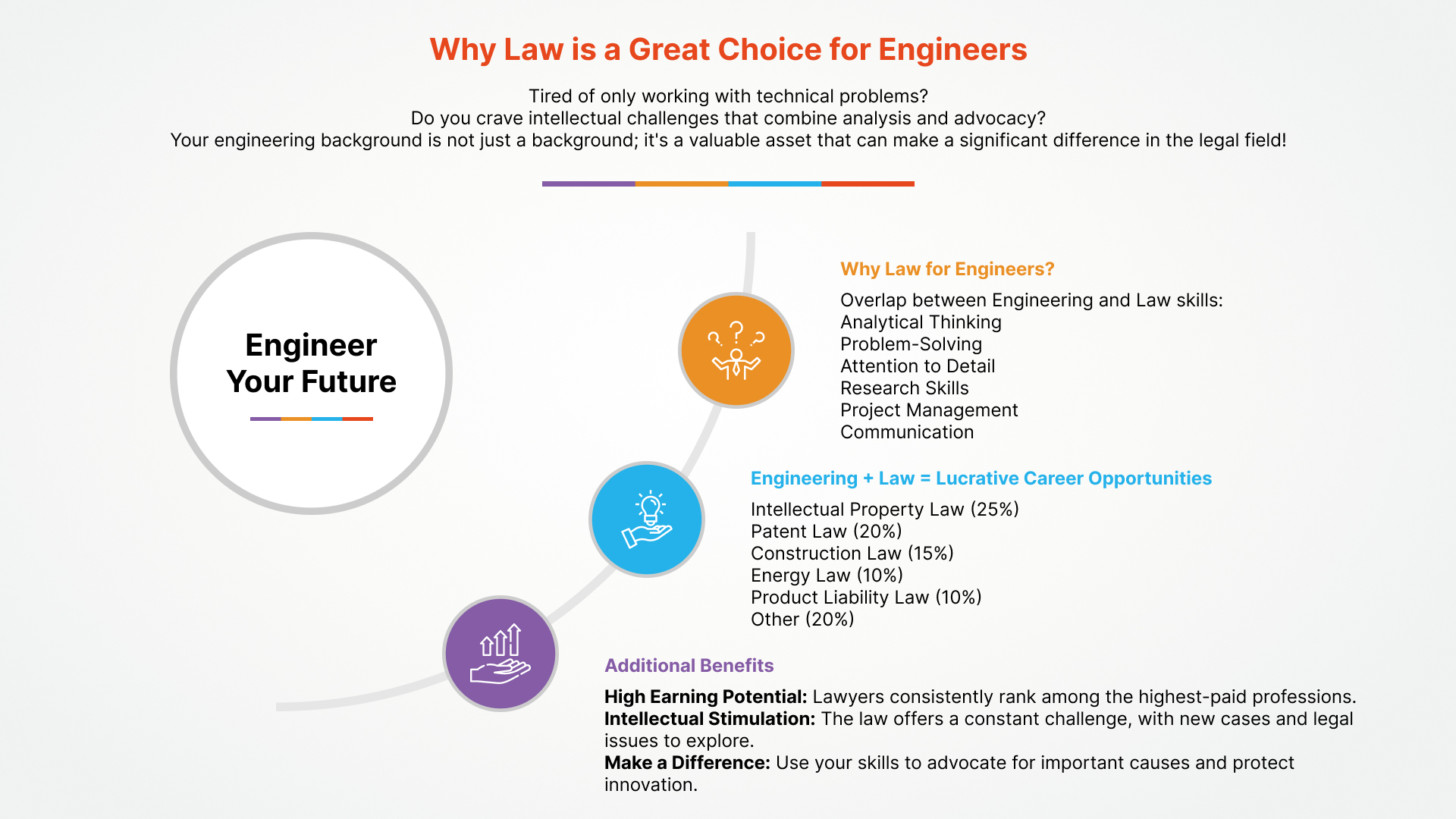
Engineering graduates can gain a good foundation for understanding legal issues related to technology. Below are some specialisations you may wish to look into.
Cyber Law
Cyber law refers to all legal issues related to digital technology. This includes cyber crime, data protection and digital transactions.
Engineering graduates, especially those with a background in computer science and information technology can utilise their knowledge.
Intellectual Property Rights (IPR) Law
Intellectual property law relates to protecting original creations.
Engineering graduates can utilise their knowledge to understand inventions and industrial design related to intellectual property.
This can include Patents, Copyrights, Trademarks and Industrial Design.
Patent Law
Patent law relates to protecting qualifying inventions. This includes understanding patent applications, invention disclosure, rights and disputes.
Engineering knowledge can help legal professionals understand technical inventions and help them connect with inventors, researchers and technology companies.
However, there are separate statutory requirements to become a registered patent agent in India. An LLB will not automatically qualify you.
Corporate Law
Corporate law relates to legal issues within businesses.
Engineering graduates working within the manufacturing, construction, infrastructure or technology industries may benefit from understanding commercial contracts and corporate law.
Environmental/Energy Law
Environmental and energy law relate to regulations around protecting the environment, controlling pollution, renewable energy and sustainable development.
Civil, mechanical and electrical engineers may find this relevant.
Construction Law
Construction law refers to legal issues related to construction. This can include contractual obligations, disputes and regulations.
Civil engineers can utilise their knowledge when working with construction contracts and infrastructure disputes.
Benefits of Pursuing LLB After Engineering
There are many benefits to studying LLB after engineering.
Strong Analytical Skills
An engineering degree will teach you how to think logically, analytically and solve problems. This can be used when researching, analysing cases and interpreting complex technical issues.
Diverse Opportunities
An engineering qualification can help you explore numerous opportunities within law firms, corporate law, technology businesses, IP and consultancy.
Technical Knowledge
An engineering qualification can help you understand issues related to patents, cyber security, infrastructure, environmental regulations and technology disputes.
Versatile
Having both an engineering and law qualification can help you understand technical and legal issues within business.
Broad Understanding
Studying law after engineering will help you understand how technology, business, regulations and society work together.
Ultimately how beneficial this will be will depend on your specialism, experience, qualifications and goals.
Career Opportunities After LLB and Engineering
Having an engineering qualification can help you explore various career options. Knowing what options are available after LLB can help engineering graduates find roles that match their background, interests and goals.
Once you have completed a qualifying LLB course and met any professional requirements, engineering graduates can explore the following career options.
| Career Role | Description |
|---|---|
| Corporate Legal Associate | Assist with contracts, compliance and corporate law. |
| Intellectual Property Professional | Work within intellectual property protection and related legal issues (depending on role). |
| Technology Law Associate | Work with legal issues related to technology. |
| Legal Consultant | Provide legal advice (depending on qualifications). |
| Construction Law | Work with infrastructure contracts, construction disputes and project related legal issues. |
| Litigation Lawyer | Represent clients (meeting any professional requirements). |
| In House Legal Professional | Help organisations with contracts, compliance and legal risk. |
Important Professional Requirements
Having an LLB will not automatically qualify you to work as an advocate.
Those wishing to work as advocates in India must meet the requirements set out by the Bar Council. This will include enrolling with the relevant State Bar Council and meeting the requirements of the All India Bar Examination (AIBE).
Those wishing to work within judicial services must meet the relevant judicial service requirements and exam requirements. There are also separate requirements to become a registered patent agent.
Skills Required to Build a Career in Law After Engineering
Alongside having the right qualifications, aspiring legal professionals should also have the following skills.
-
Legal Research: Researching, interpreting and analysing Statutes, Regulations and Judgements.
-
Communication: Presenting arguments and explaining complex concepts.
-
Critical Thinking: Analysing evidence, identifying legal issues and creating logical arguments.
-
Technical Knowledge: Using engineering knowledge to understand legal issues related to technology.
-
Writing: Writing legal documents.
-
Negotiation: Understanding different perspectives and finding practical solutions.
Internships, mooting, legal research and hands on experience can help students develop these skills.
Why Choose CGC University, Mohali?
Choosing the right university to study can play an important role within your career. Students searching for the Best LLB College in Mohali should understand the course curriculum, faculty expertise, learning environment, practical exposure and professional development opportunities available.
CGC University, Mohali offers law education to those wishing to understand legal principles. Those wishing to become an engineering graduate should ensure they understand what LLB course is available, entry requirements, course content and application process to ensure it is the right choice for them.
Check the official information for the course and current admission guidelines.
Conclusion
Taking up an LLB after engineering can be a great move for graduates wishing to explore a career in law. It combines the analytical and technical skills gained from an engineering degree with the knowledge needed to understand regulations, contracts, intellectual property and technology disputes.
Whether you are interested in cyber law, patent law, corporate law, environmental law or construction law, a law course can help you explore new opportunities outside of traditional engineering roles.
Ensure you choose the right 3-year LLB course, understand what entry requirements you need to meet and develop your legal skills.
Frequently Asked Questions (FAQs)
Q1. Can I do LLB after B.Tech?
Yes! Engineering graduates can apply for a 3-year LLB course once they meet the entry requirements of the university.
Q2. What are the entry requirements for LLB after engineering?
Generally students will need a recognised bachelor degree and meet the minimum mark requirements.
Q3. What entrance exams are available for 3-year LLB?
MH CET Law (3-Year LLB), CUET-PG for participating universities and University entrance exams.
Q4. What law specialisation should engineering graduates do?
Depending on your background you may find Cyber law, patent law, intellectual property rights, construction law and environmental law relevant.
Q5. Can engineering graduates become lawyers after LLB?
Yes! Once you have completed a qualifying LLB degree and met the requirements of the Bar Council you can become a lawyer.